Database
The NIST virtual SRM database contains an electronic catalog
of raw surface topographic images, filtered surface images, and their calculated surface
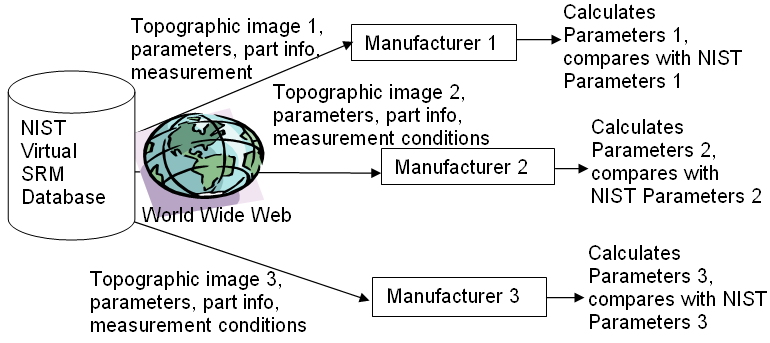
parameters. The users are able to download these surface topographic images from
the database and use them to test their own software. This
is shown in the figure below. The database is used to organize information
for data sets generated by measurement and by simulation. Machine condition
parameters and other process parameters are stored along with part information.
In addition, the database is used to store surface topography data and NIST-calculated parameters
from those data. With this database, measurement
instrument designers or customers are able to query information through
the Internet and use it to validate parameter calculations and the implementation
of their algorithms. The database provides a search engine for querying information
based on parameters, instrument type, processes, filenames, part names, times
and dates. It also provides tools for visualizing the information
after queries and loading of the data sets from the database to the analysis software.
The database was modeled using the Entity-Relationship (ER) diagram. The
ER diagram is a graphical representation of the requirements of the database.
The ER model describes data as entities, attributes, and their relationships.
The ER diagram of the specimen database includes the following entities [1]:
- PART representing identification information of a machined part.
- PROCESS representing information on how a part is made. It
contains information about the manufacturing process and process parameters.
- MEASUREMENT representing instrument related information used to measure
a part.
- DATA FILE, which stores data generated by a stylus instrument or by
simulation. Currently, all the data are simulated.
- ANALYSIS DATA, which stores analysis data, such as surface
parameters and filtered data.
Reference
1. Ramez Elmasri and Shamkant Navathe, Fundamentals of Database System, Addison-Wesly Publishing Company, Meno Park, CA, 1994